The evening/morning star
Venus
What you can realistically expect
The brightest planet — often mistaken for an aircraft light.
BeginnerWhat is it?
Venus is nearly Earth's twin in size but shrouded in a thick, reflective atmosphere that makes it exceptionally bright. Depending on where it is in its orbit, it appears as the evening star or the morning star.
Why observe it?
Venus's phases (crescent, half, full) were part of Galileo's evidence that planets orbit the Sun.
What will I see?
Naked eye
Extremely bright — brighter than any star. Steady white/cream light.
Binoculars
A tiny disc rather than a point of light. Phase may be discernible when Venus is a crescent.
Small telescope
A clearly-shaped disc showing phases like the Moon. Surface detail is not visible in normal wavelengths — the atmosphere is opaque.
Reference imagery from long-exposure photography usually shows far more colour and structure than the human eye can see through a telescope.
Reference image
Processed image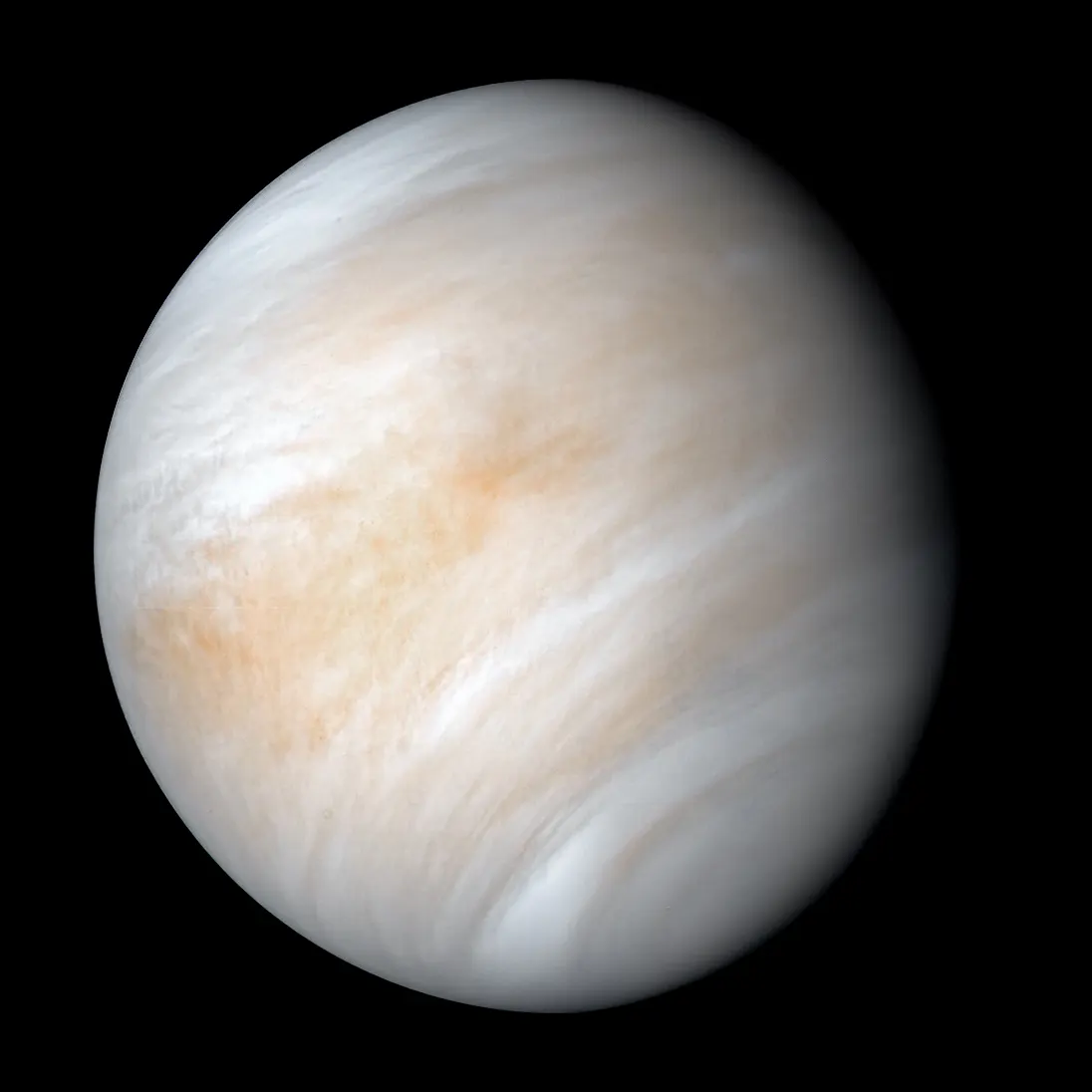
NASA/JPL-Caltech · NASA Science
Long-exposure or processed astronomy images can show much more colour and structure than you may see through an eyepiece.
Observing tips
- Best observed against twilight rather than a fully dark sky — the contrast reduces glare.
- The disc changes size dramatically as Venus's distance to Earth changes over its orbit.
Interesting facts
- The hottest planet in the Solar System — hotter than Mercury despite being farther from the Sun.
- Reflects around 70% of the sunlight that hits its cloud tops.