The ringed planet
Saturn
What you can realistically expect
Famous for its rings — one of the most memorable sights in a small telescope.
BeginnerWhat is it?
Saturn is a gas giant slightly smaller than Jupiter, but its spectacular ring system makes it the most recognisable planet in a telescope. The rings are made of countless icy particles.
What will I see?
Naked eye
A steady, slightly yellow-cream point. Not as bright as Jupiter or Venus but easy to identify.
Small telescope
The rings are clearly visible even at moderate magnification. Titan, the brightest moon, appears as a nearby star.
Medium telescope
The Cassini Division (dark gap in the rings) can become visible under steady seeing. Additional moons and subtle cloud bands may appear.
Reference imagery from long-exposure photography usually shows far more colour and structure than the human eye can see through a telescope.
Reference image
Photograph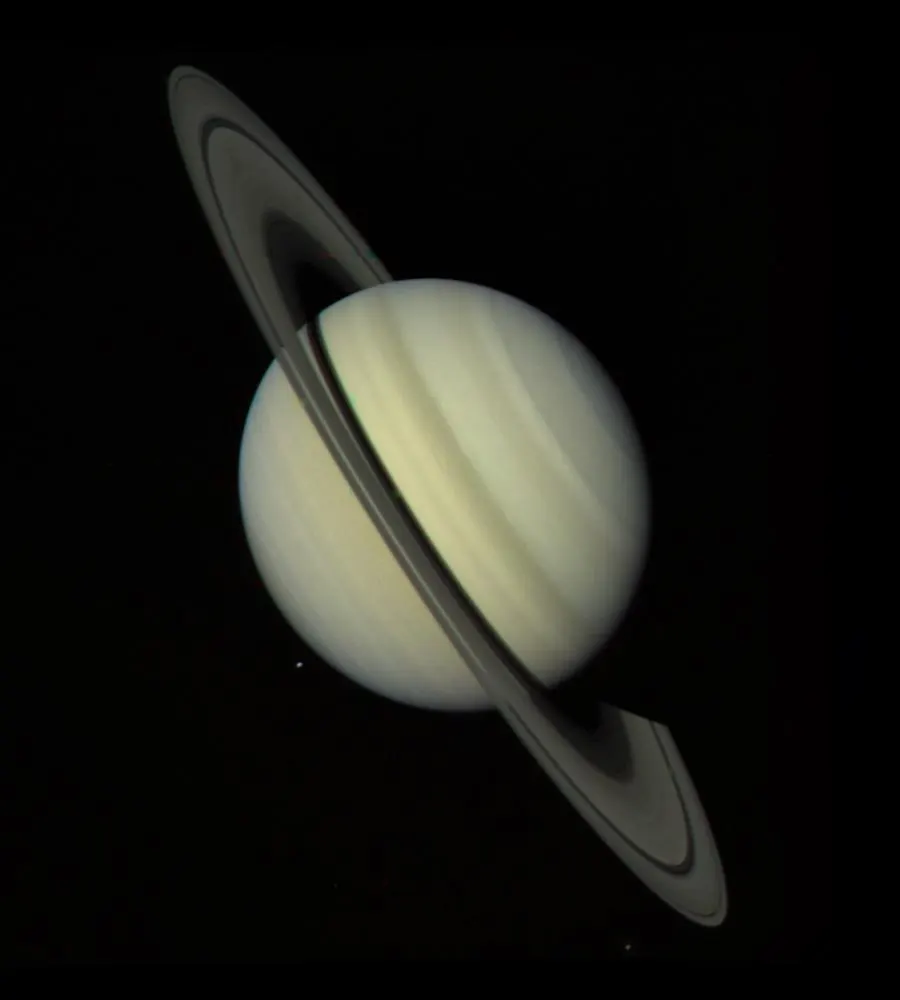
NASA/JPL · NASA Science
Long-exposure or processed astronomy images can show much more colour and structure than you may see through an eyepiece.
Observing tips
- The rings' tilt changes over years — sometimes wide-open, sometimes edge-on and nearly invisible.
- Steady atmospheric seeing matters much more than large aperture for detail on Saturn.
Interesting facts
- About 9 times Earth's diameter, but so low in density it would float in water.
- The rings are only ~10 metres thick in most places despite being ~280,000 km wide.