Earth's natural satellite
Moon
What you can realistically expect
Earth's only natural satellite — the easiest and most rewarding beginner target.
BeginnerWhat is it?
The Moon is our closest neighbour in space and the brightest object in the night sky after the Sun. It changes appearance dramatically over its 29.5-day cycle as different regions catch sunlight at different angles.
Why observe it?
No target rewards patience like the Moon. Its craters, mountains, and vast dark plains (maria) are visible in almost any telescope, and the view changes every night.
What will I see?
Naked eye
The familiar face of the Moon with obvious light and dark regions. Shape and orientation change through the month.
Binoculars
Sharp detail along the day-night terminator, where shadows are longest. Individual crater rims become visible.
Small telescope
Dozens of large craters, mountain ranges, and complex terrain. Detail is most dramatic near the terminator, not on the fully-lit portion.
Medium telescope
Fine crater chains, rilles (valleys), and central mountain peaks. Steady seeing matters at higher magnifications.
Astrophotography
PhotographyEven a phone held to the eyepiece can capture recognisable Moon photographs. Long-exposure imaging is not needed.
Reference imagery from long-exposure photography usually shows far more colour and structure than the human eye can see through a telescope.
Reference image
Photograph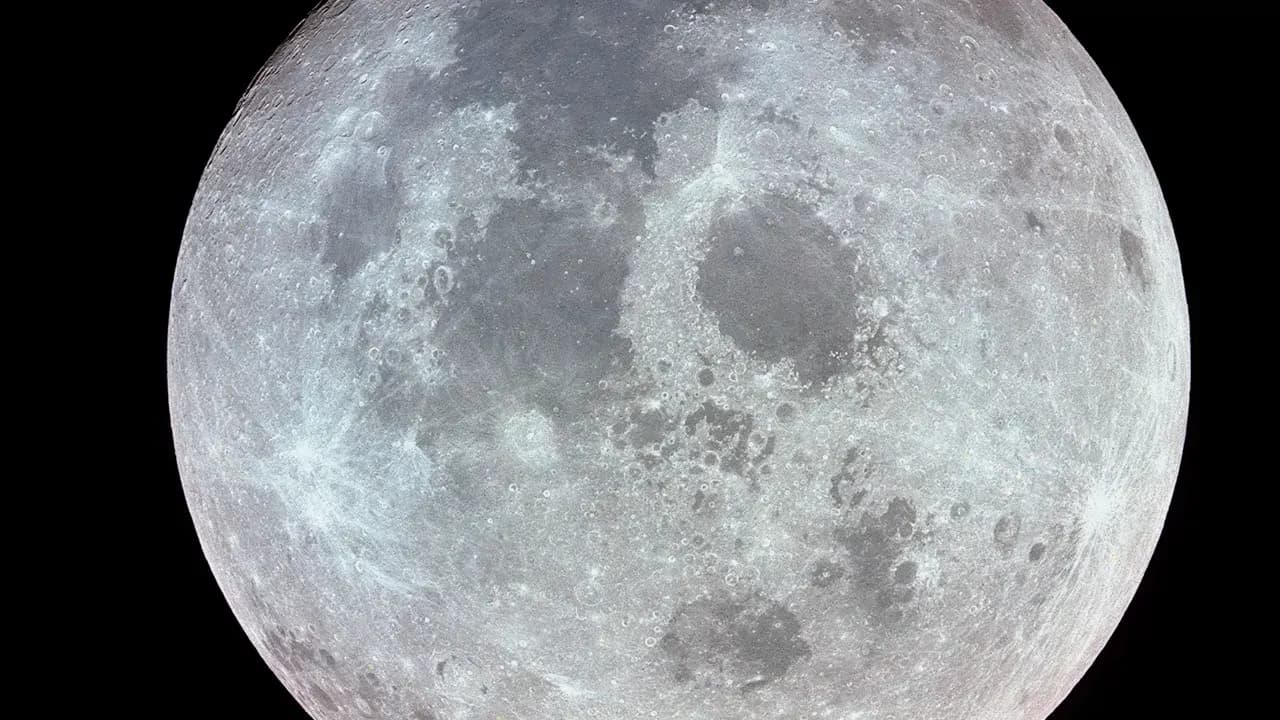
NASA / Apollo 11 / Johnson Space Center · NASA Science
Long-exposure or processed astronomy images can show much more colour and structure than you may see through an eyepiece.
Observing tips
- Observe when the Moon is a crescent, quarter, or gibbous — not full. The terminator creates the dramatic shadows that reveal detail.
- A neutral-density moon filter is helpful with medium and larger telescopes to reduce glare.
- Detail changes every night — a favourite crater looks different at different phases.
Interesting facts
- About 384,000 km away — light takes 1.3 seconds to reach us.
- Roughly a quarter the diameter of Earth.
- Rotates once per orbit, so it always shows Earth roughly the same face.