Innermost planet
Mercury
What you can realistically expect
The innermost planet — always low, close to sunrise or sunset.
IntermediateWhat is it?
Mercury is the smallest and innermost planet. It never appears far from the Sun in our sky, which limits observation to brief windows after sunset or before sunrise.
What will I see?
Naked eye
A bright star-like point close to the horizon, only for a short window during favourable elongations.
Small telescope
A small disc with visible phases similar to the Moon, but subtle. Atmospheric turbulence near the horizon usually blurs surface detail.
Reference imagery from long-exposure photography usually shows far more colour and structure than the human eye can see through a telescope.
Reference image
Processed image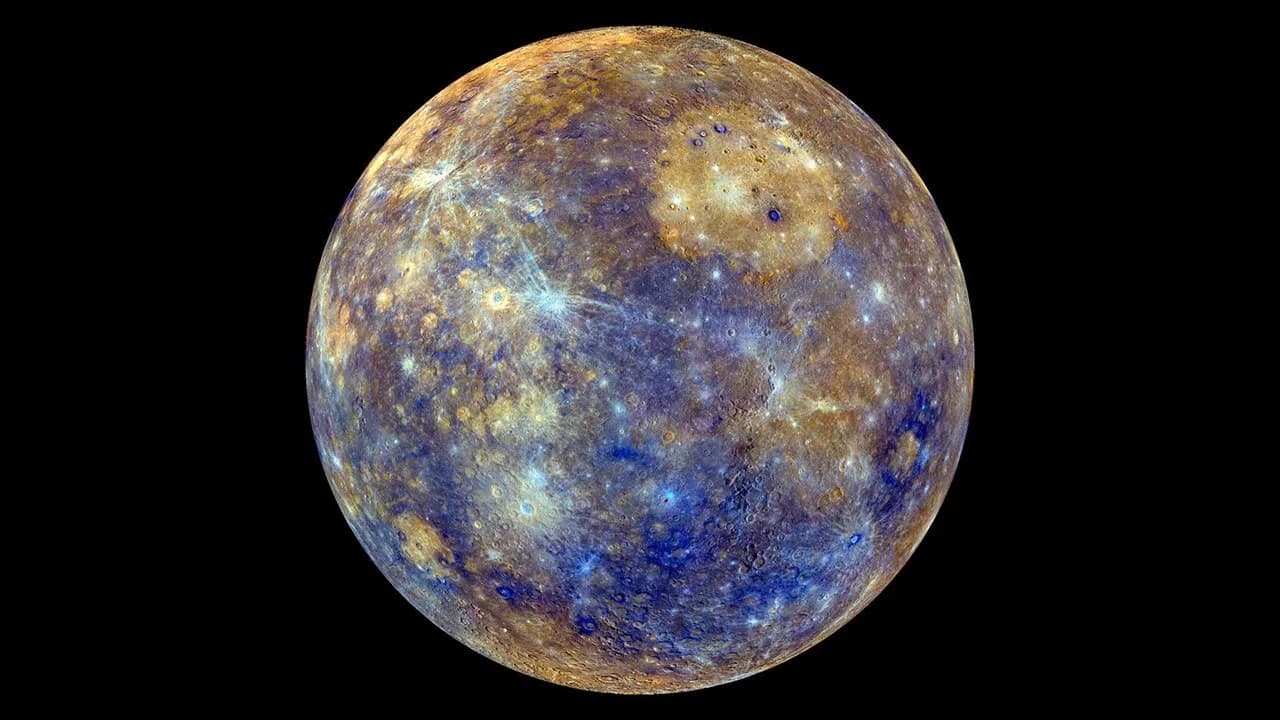
NASA/Johns Hopkins University Applied Physics Laboratory/Carnegie Institution of Washington · NASA Science
Long-exposure or processed astronomy images can show much more colour and structure than you may see through an eyepiece.
Observing tips
- Only look for Mercury when the app confirms it is above the horizon in dark or twilight skies — never search near the Sun.
- Best when Mercury is at greatest elongation. Even then it may only be 15–20° from the Sun.
Interesting facts
- About 58 million km from the Sun on average.
- Days on Mercury are longer than its year — one solar day = ~176 Earth days.