The red planet
Mars
What you can realistically expect
The red planet — its colour is unmistakable to the naked eye.
BeginnerWhat is it?
Mars is roughly half the diameter of Earth, with a rusty-red surface. Its apparent size and detail from Earth vary dramatically depending on where the two planets are in their orbits — the best views come around opposition, roughly every 26 months.
What will I see?
Naked eye
An obvious reddish-orange point of light. Brighter than most stars when near opposition.
Small telescope
A small orange-red disc. Around opposition, dark surface markings and a bright polar cap may be visible.
Medium telescope
Surface features are subtle but real: dark plains, the bright polar cap, and occasional dust storms.
Reference imagery from long-exposure photography usually shows far more colour and structure than the human eye can see through a telescope.
Reference image
Processed image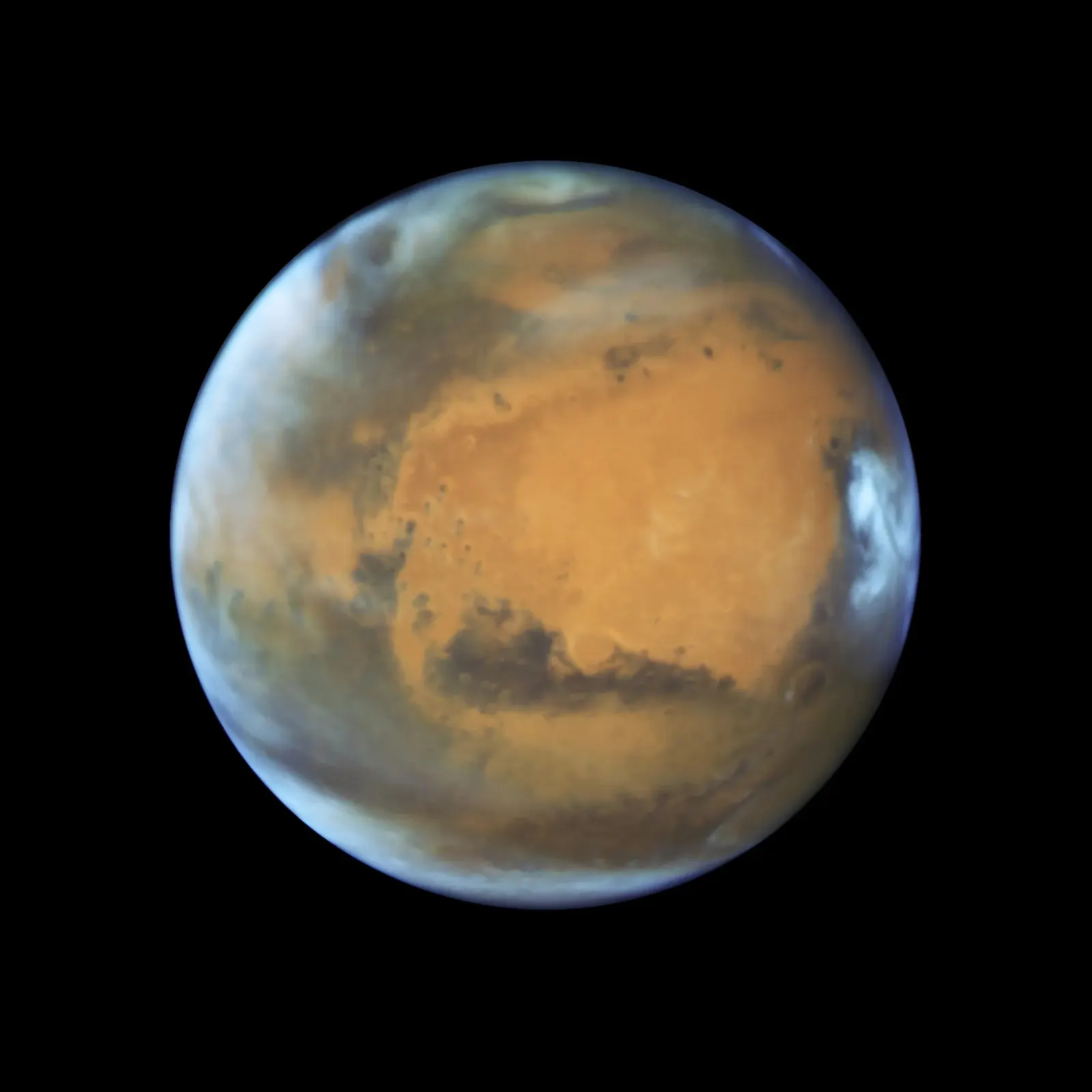
NASA, ESA, the Hubble Heritage Team (STScI/AURA), J. Bell (ASU), and M. Wolff (Space Science Institute) · NASA Science
Long-exposure or processed astronomy images can show much more colour and structure than you may see through an eyepiece.
Observing tips
- Wait for Mars to be near opposition for meaningful telescope detail. Between oppositions, the disc is small and features are hard to see.
- High magnification helps — but only when the atmosphere is steady.
Interesting facts
- About half the diameter of Earth.
- Has the tallest volcano and deepest canyon in the Solar System.
- Two tiny moons: Phobos and Deimos.