Galaxies · Pisces
M74
NGC 628 · M74
Details
Magnitude
9.40
Angular size
10.5′ × 9.5′
Messier
M74
NGC
628
What you can realistically expect
A famously faint face-on spiral — the classic 'photograph is much easier than eyepiece' target.
ChallengingWhat is it?
M74 is a beautiful face-on spiral galaxy in Pisces, about 32 million light-years away. Despite its dramatic astrophotographic appearance, it is one of the most notoriously difficult Messier objects to observe visually — its low surface brightness spreads its light thinly.
Why observe it?
M74 is a perfect example of why astrophotography is not the same as visual observation. In photographs it is a stunning spiral; in the eyepiece it is a very diffuse, faint glow — a valuable lesson in realistic expectations.
What will I see?
Small telescope
Very faint and diffuse — often just a barely-detectable smudge, if visible at all. Light-polluted skies can hide it completely.
Medium telescope
Under dark skies, a soft round glow with a slightly brighter core. Spiral arms are essentially invisible visually.
Astrophotography
PhotographyLong exposures reveal the full face-on spiral structure and the delicate arm pattern. This is why photographs of M74 look so dramatic.
Reference imagery from long-exposure photography usually shows far more colour and structure than the human eye can see through a telescope.
Reference image
Processed image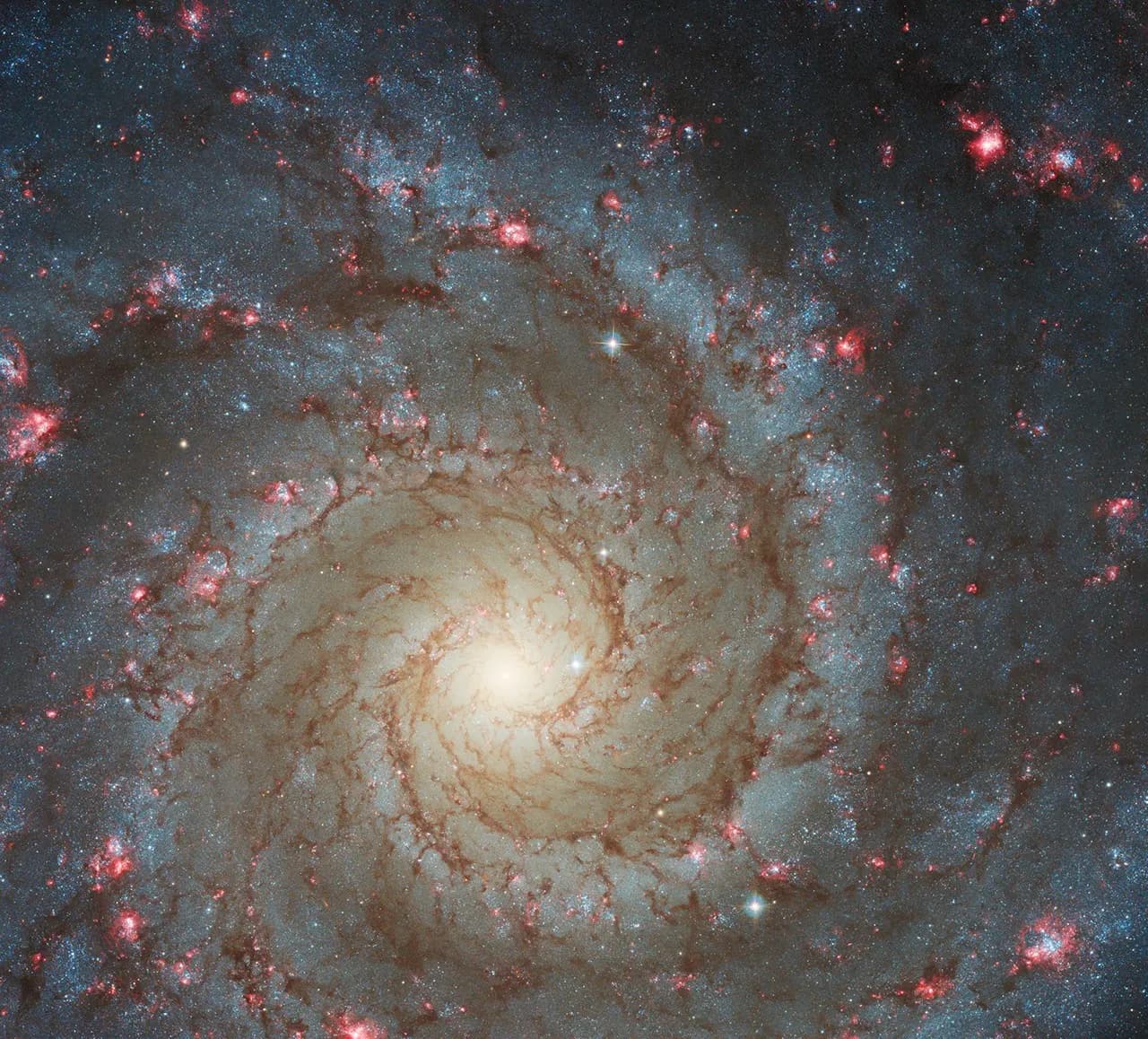
NASA, ESA and the Hubble Heritage (STScI/AURA)-ESA/Hubble Collaboration; Acknowledgment: R. Chandar (University of Toledo) and J. Miller (University of Michigan) · NASA Science / Hubble Messier catalog
Long-exposure or processed astronomy images can show much more colour and structure than you may see through an eyepiece.
Observing tips
- Dark skies are essential. Try only on nights of good transparency, with the galaxy near the meridian.
- Averted vision (looking slightly to the side of the galaxy) helps pick up its faint light.
- If the phone points at M74 correctly but you see nothing, the Finder is not broken — this is genuinely a difficult visual target.
Interesting facts
- About 32 million light-years away.
- Contains an estimated 100 billion stars.