Nebulae · Lyra
Ring Nebula
NGC 6720 · M57
Details
Magnitude
8.80
Angular size
1.4′ × 1′
Messier
M57
NGC
6720
What you can realistically expect
A tiny smoke-ring in Lyra — the classic amateur planetary nebula.
IntermediateWhat is it?
The Ring Nebula is a planetary nebula: gas ejected by a dying star, glowing under the ultraviolet light of the tiny hot remnant at its centre. It lies about 2,300 light-years away.
What will I see?
Binoculars
A tiny fuzzy 'star' — difficult to identify without knowing exactly where to look.
Small telescope
A small but distinctly ring-shaped smoke ring at moderate magnification. Central hole is visible.
Medium telescope
The ring's shape is unmistakable. Very hard to detect the extremely faint central star visually.
Astrophotography
PhotographyPhotographs reveal delicate structure and colour: blue-green in the interior, red-pink at the edges.
Reference imagery from long-exposure photography usually shows far more colour and structure than the human eye can see through a telescope.
Reference image
Processed image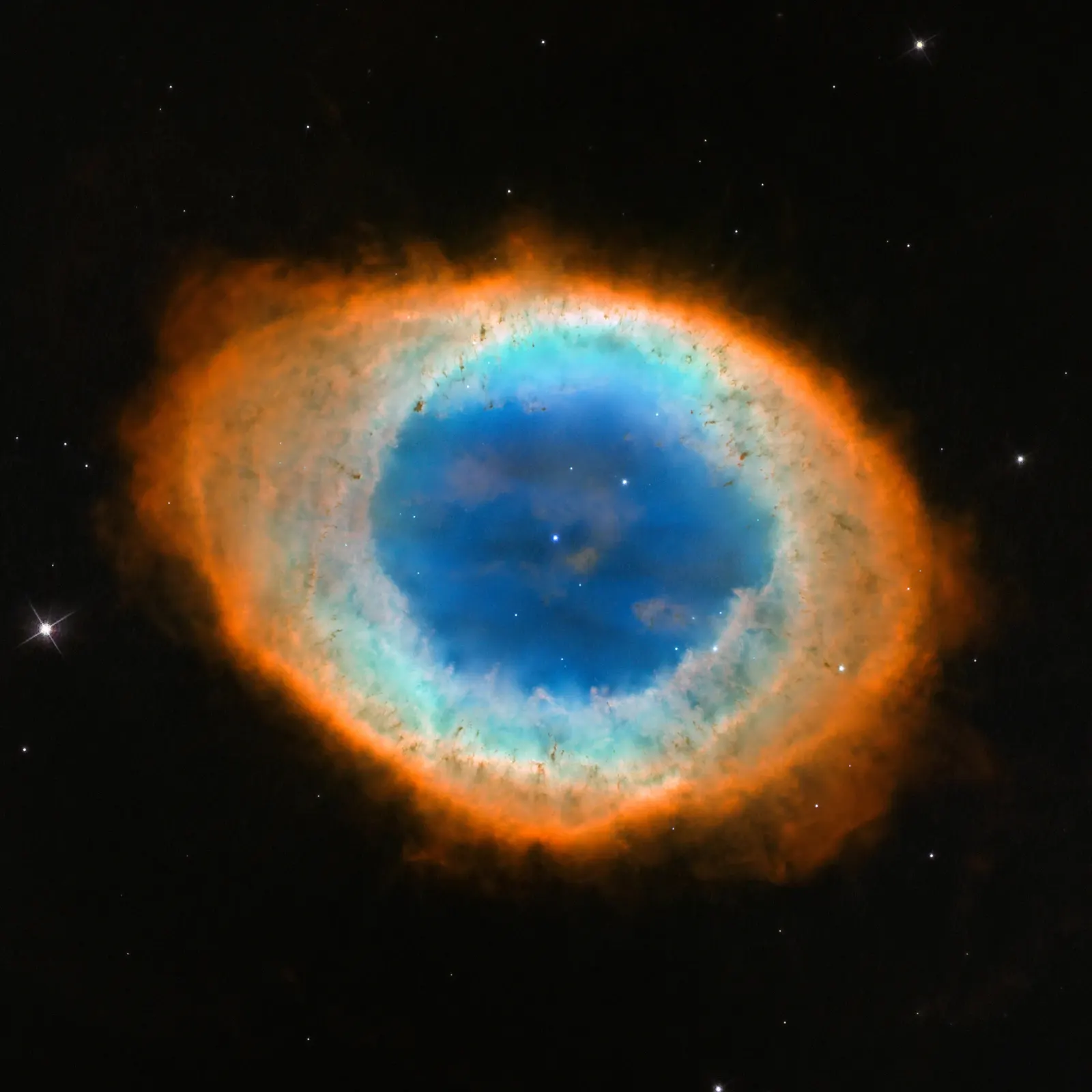
NASA, ESA and the Hubble Heritage (STScI/AURA)-ESA/Hubble Collaboration · NASA Science / Hubble Messier catalog
Long-exposure or processed astronomy images can show much more colour and structure than you may see through an eyepiece.
Observing tips
- Use higher magnification than typical for deep-sky objects — the nebula is small.
- An O-III filter dramatically improves visibility under light-polluted skies.
- Located between the two southern stars of Lyra's parallelogram.
Interesting facts
- About 1 light-year across.
- The central star will eventually cool into a white dwarf.