Nebulae · Orion
Orion Nebula
NGC 1976 · M42
Details
Magnitude
4.00
Angular size
85′ × 60′
Messier
M42
NGC
1976
What you can realistically expect
The brightest emission nebula visible from Earth — a stellar nursery in Orion's Sword.
BeginnerWhat is it?
The Orion Nebula is a vast cloud of gas and dust where new stars are actively forming. It lies about 1,300 light-years away in the constellation Orion, in the region called Orion's Sword just below the three belt stars.
Why observe it?
One of the few deep-sky objects where visual detail through a telescope is genuinely dramatic — and one of the closest active star-forming regions.
What will I see?
Naked eye
A faint fuzzy 'star' in the middle of Orion's Sword under moderately dark skies.
Binoculars
A clear grey-green glow with a bright core.
Small telescope
Obvious nebulosity with clear structure, wispy extensions, and the four bright stars of the Trapezium cluster embedded in the centre.
Medium telescope
Fine detail in the wings and 'fish-mouth' region. On steady nights, additional stars in the Trapezium become visible.
Astrophotography
PhotographyPhotographs show vivid pink and red colours from ionised hydrogen. Visually, the eye perceives the nebula mostly as grey-green.
Reference imagery from long-exposure photography usually shows far more colour and structure than the human eye can see through a telescope.
Reference image
Processed image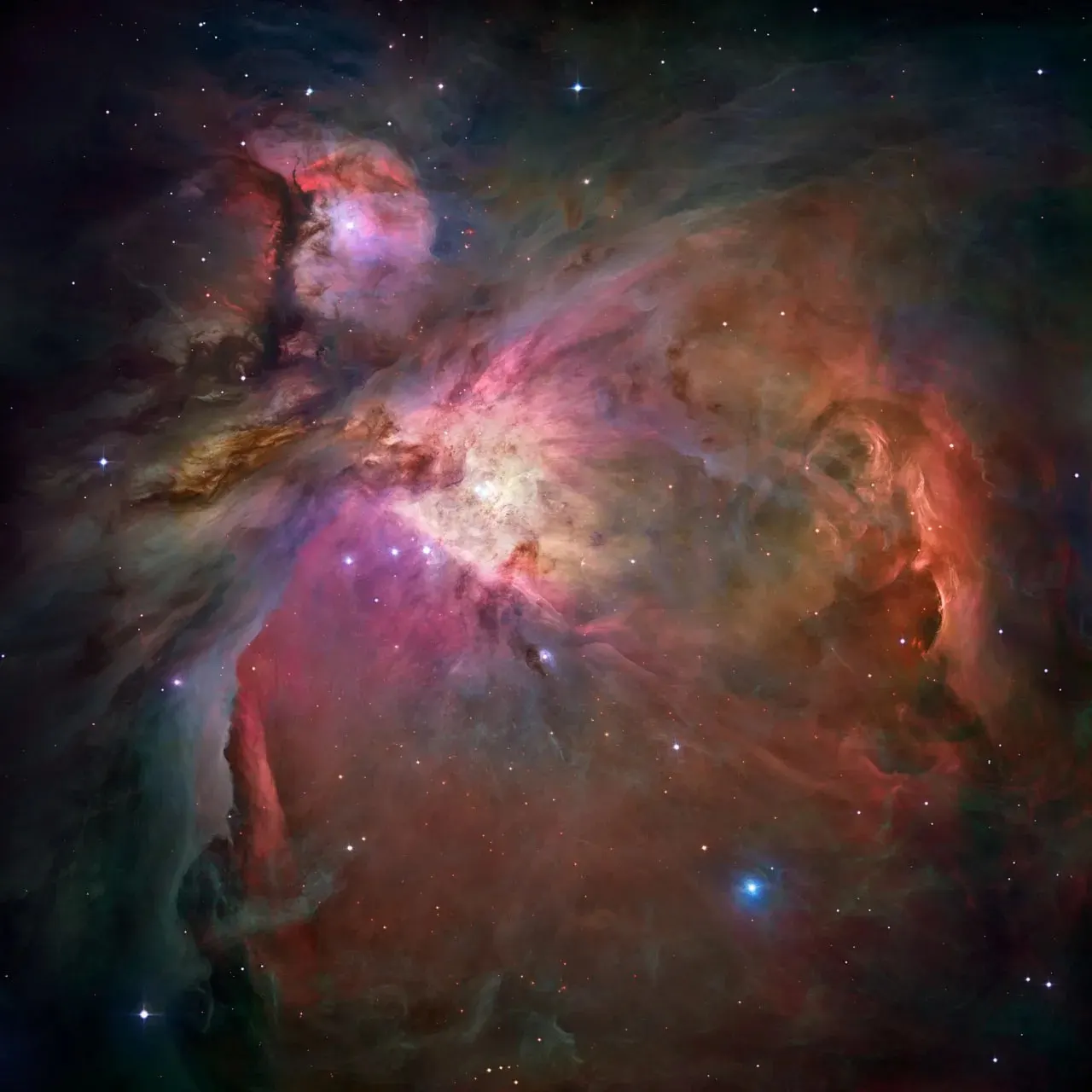
NASA, ESA, M. Robberto (Space Telescope Science Institute/ESA) and the Hubble Space Telescope Orion Treasury Project Team · NASA Science / Hubble Messier catalog
Long-exposure or processed astronomy images can show much more colour and structure than you may see through an eyepiece.
Observing tips
- Best observed on a moonless night with dark skies.
- Low-to-moderate magnification shows the widest structure; higher magnification reveals the Trapezium stars.
- A UHC or O-III nebula filter can enhance contrast under light pollution.
Interesting facts
- Around 24 light-years across.
- One of the closest regions of active star formation.
- Visible from both hemispheres in northern-hemisphere winter / southern-hemisphere summer.