Galaxies · Andromeda
Andromeda Galaxy
NGC 224 · M31
Details
Magnitude
3.40
Angular size
178′ × 63′
Messier
M31
NGC
224
What you can realistically expect
The nearest large galaxy — and one of the most distant objects visible to the naked eye.
BeginnerWhat is it?
The Andromeda Galaxy is a huge spiral galaxy of hundreds of billions of stars, roughly 2.5 million light-years away. It is the largest member of our Local Group of galaxies alongside the Milky Way.
Why observe it?
The photons entering your eye left Andromeda before modern humans existed. It is one of the most distant objects visible to the unaided eye.
What will I see?
Naked eye
A very faint elongated fuzzy patch under dark skies. Not visible from light-polluted cities.
Binoculars
A brighter oval glow with a distinctly brighter central region.
Small telescope
A large soft oval glow with a bright core. The galaxy extends far beyond most eyepiece fields of view. Two companion galaxies (M32 and M110) may be visible as small round smudges nearby.
Astrophotography
PhotographyLong-exposure photography reveals the extended disk, dust lanes, and blue star-forming regions that the eye simply cannot see.
Reference imagery from long-exposure photography usually shows far more colour and structure than the human eye can see through a telescope.
Reference image
Processed image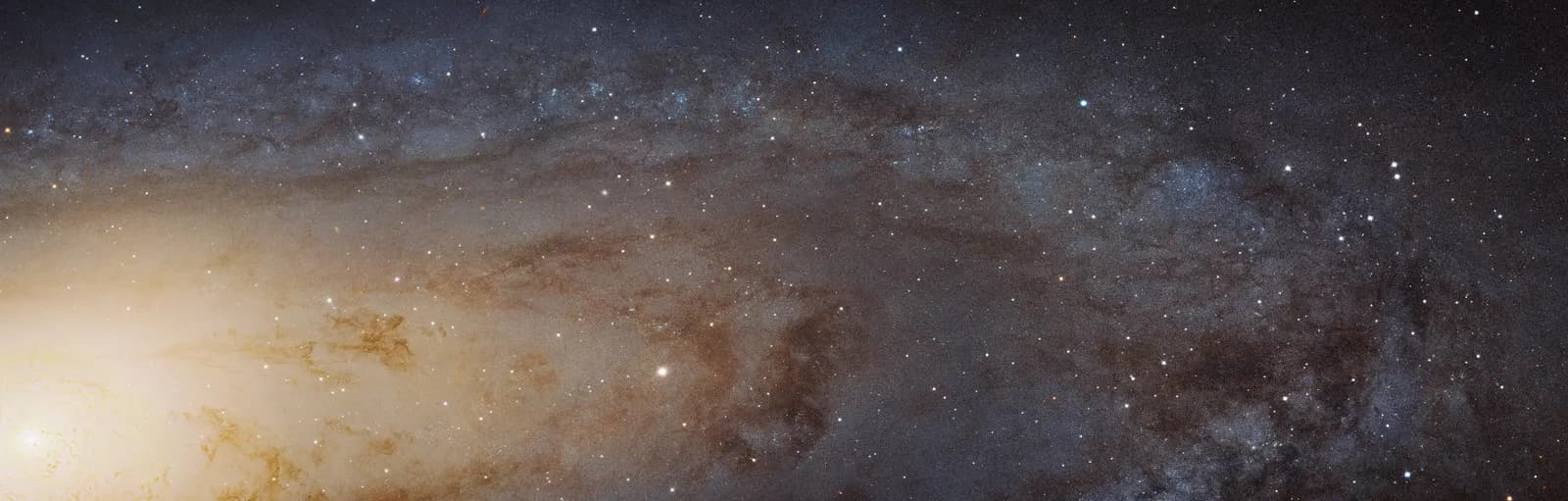
NASA, ESA, J. Dalcanton, B.F. Williams, L.C. Johnson (University of Washington), the PHAT team, and R. Gendler · NASA Science / Hubble Messier catalog
Long-exposure or processed astronomy images can show much more colour and structure than you may see through an eyepiece.
Observing tips
- Dark skies matter enormously. From a bright city, Andromeda may not be visible at all.
- Use low magnification — the galaxy is roughly 6 full-Moon diameters across in the sky.
- Look near the constellation Andromeda, above the great square of Pegasus.
Interesting facts
- About 220,000 light-years across — larger than the Milky Way.
- On a collision course with the Milky Way, expected in about 4 billion years.
- Contains an estimated 1 trillion stars.