Globular clusters · Hercules
Hercules Cluster
NGC 6205 · M13
Details
Magnitude
5.80
Angular size
20′
Messier
M13
NGC
6205
What you can realistically expect
The finest globular cluster in the northern sky — hundreds of thousands of stars in a single ball.
BeginnerWhat is it?
M13 is a spectacular globular cluster of several hundred thousand stars gravitationally bound in a roughly spherical swarm. It lies about 22,000 light-years away in the constellation Hercules.
What will I see?
Naked eye
A very faint fuzzy 'star' under dark skies, next to two of the four stars of the Hercules Keystone.
Binoculars
An obvious round fuzzy patch — clearly not a star.
Small telescope
A dense round glow with grainy texture near the edges — individual stars begin to resolve.
Medium telescope
Hundreds of individual stars resolved across the cluster. The outer regions especially become a sparkle of pinpoints.
Reference imagery from long-exposure photography usually shows far more colour and structure than the human eye can see through a telescope.
Reference image
Processed image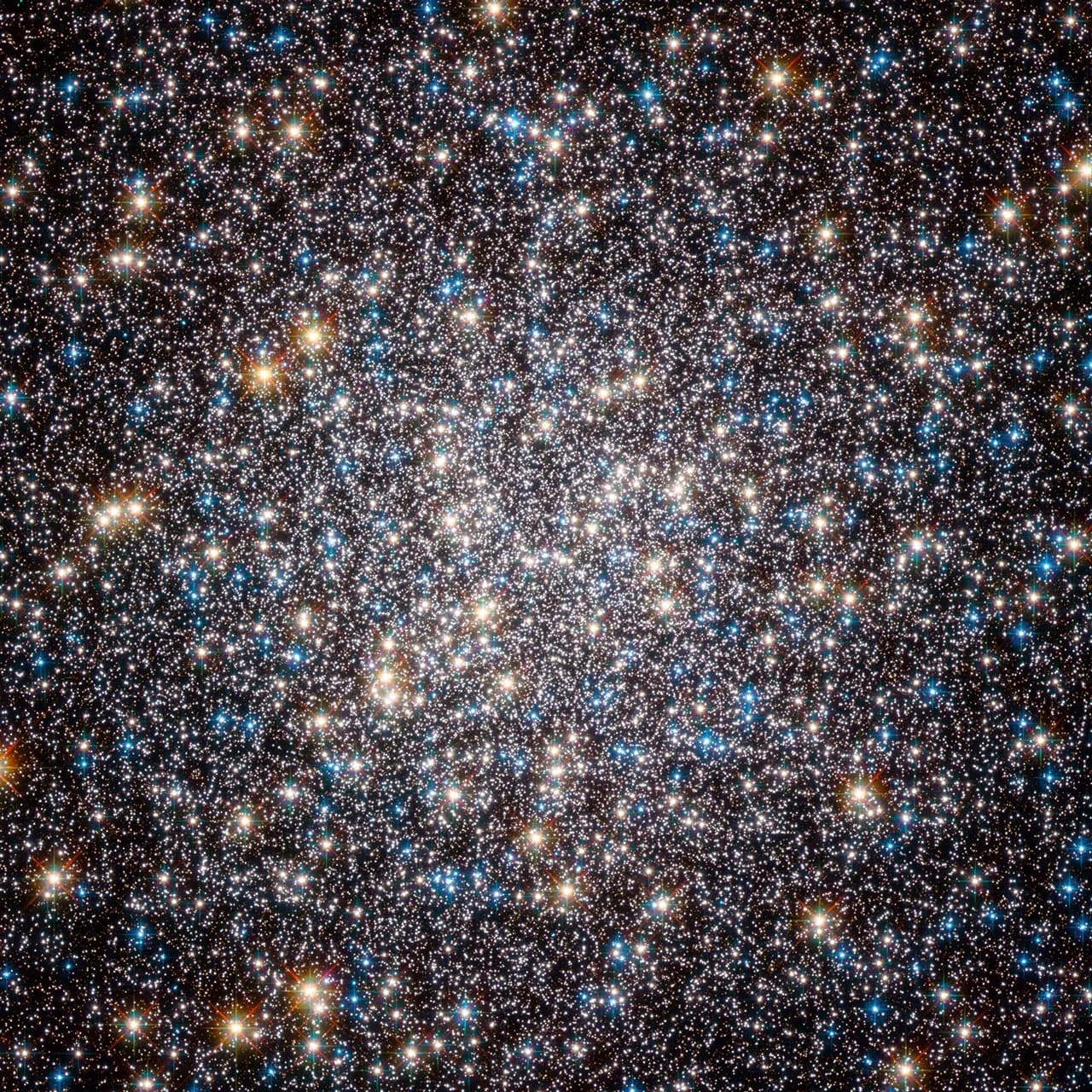
NASA, ESA, and the Hubble Heritage Team (STScI/AURA); Acknowledgment: C. Bailyn (Yale University), W. Lewin (Massachusetts Institute of Technology), A. Sarajedini (University of Florida), and W. van Altena (Yale University) · NASA Science / Hubble Messier catalog
Long-exposure or processed astronomy images can show much more colour and structure than you may see through an eyepiece.
Observing tips
- Best observed at high altitude, when Hercules is well overhead.
- Larger apertures reveal more resolved stars — this is a target that rewards more aperture.
Interesting facts
- About 145 light-years across.
- Contains an estimated 300,000 stars.
- Roughly 12 billion years old.