The largest planet
Jupiter
What you can realistically expect
The largest planet — and the easiest to see with real telescopic detail.
BeginnerWhat is it?
Jupiter is the giant of the Solar System — more than twice the mass of all the other planets combined. Even a small telescope reveals its cloud belts and four large moons.
Why observe it?
The four Galilean moons (Io, Europa, Ganymede, Callisto) change positions from night to night — a live demonstration of a mini solar system.
What will I see?
Naked eye
One of the brightest objects in the night sky. Steady, non-twinkling.
Binoculars
A small disc with 2–4 star-like points beside it — the Galilean moons.
Small telescope
A clearly-shaped disc with at least two dark equatorial belts. The moons are easy pinpoints; their positions change hour by hour.
Medium telescope
Multiple cloud bands, festoons, and sometimes the Great Red Spot when it faces Earth. Moon shadows on the disc are visible during transits.
Reference imagery from long-exposure photography usually shows far more colour and structure than the human eye can see through a telescope.
Reference image
Processed image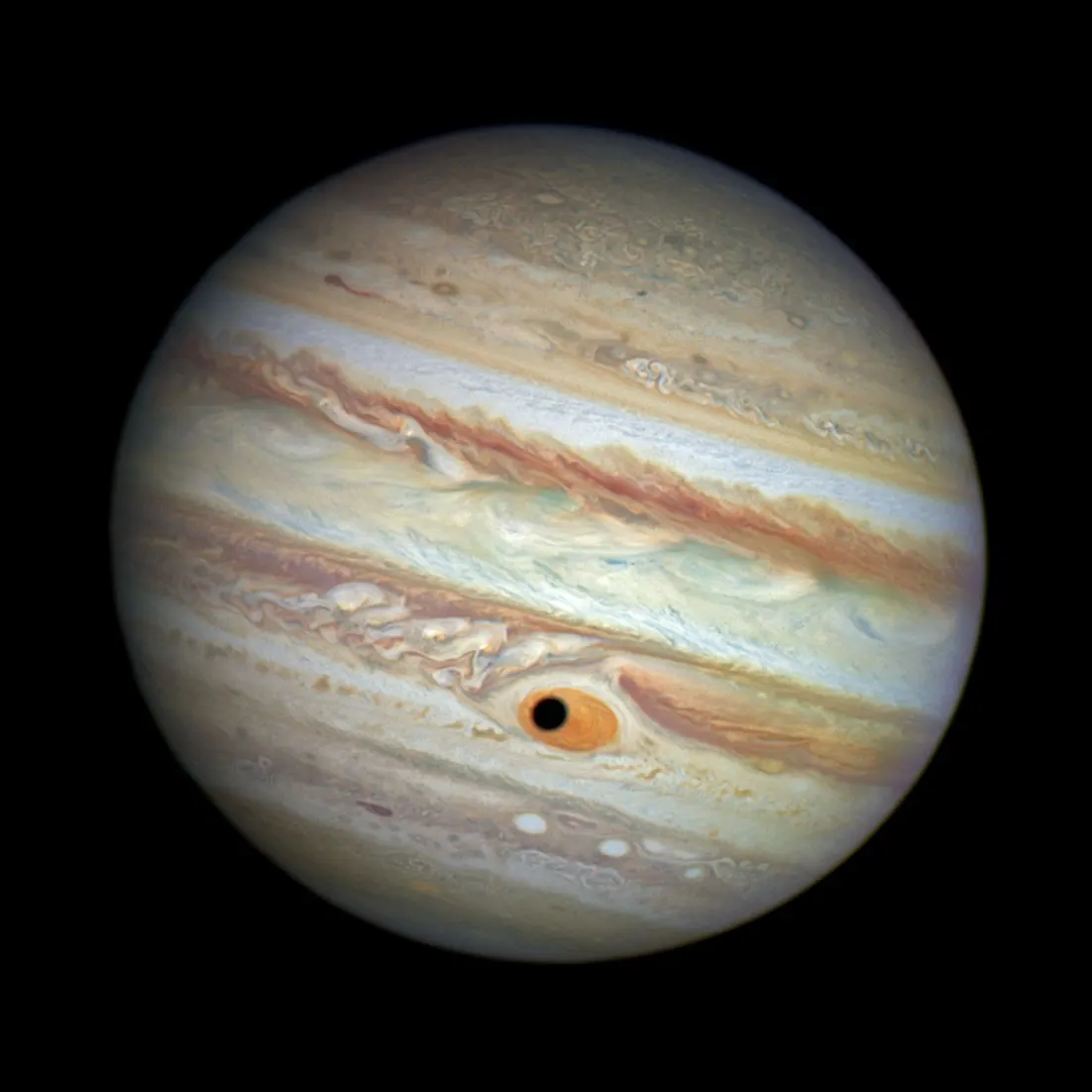
NASA, ESA, A. Simon (NASA Goddard Space Flight Center), G. Orton (NASA Jet Propulsion Laboratory), J. Rogers (University of Cambridge, UK), and M. Wong and I. de Pater (University of California, Berkeley) · NASA Science
Long-exposure or processed astronomy images can show much more colour and structure than you may see through an eyepiece.
Observing tips
- Note the positions of the moons — they will visibly change if you look again in an hour, and dramatically the next night.
- Use moderate magnification. Very high magnification only helps in steady seeing.
Interesting facts
- About 11 times Earth's diameter.
- The Great Red Spot is a storm larger than Earth that has raged for centuries.
- Has at least 95 known moons; the four brightest are visible in binoculars.